
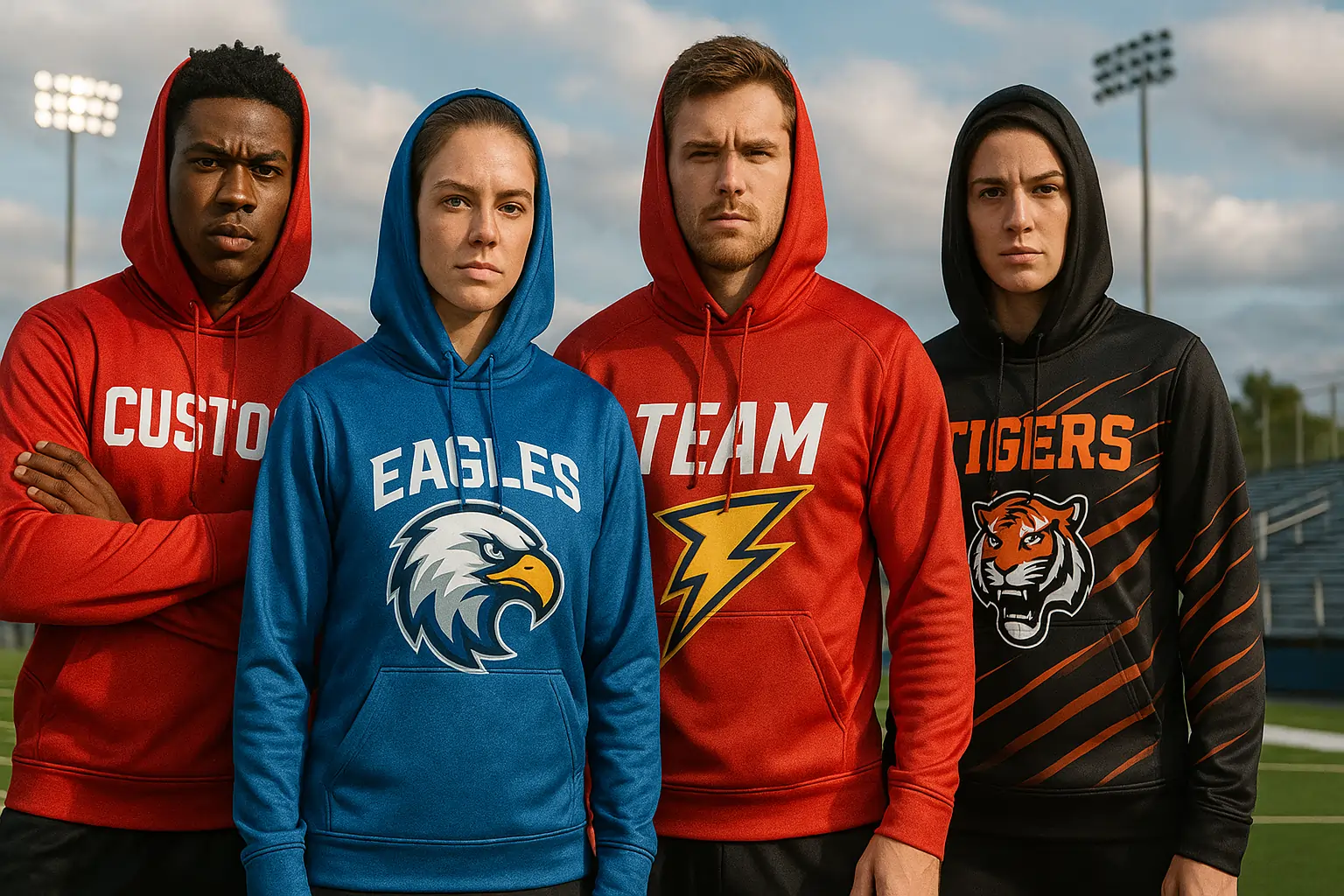
Sublimated Custom Hoodies That Bring Your Team Identity to Life
Sublimation hoodies give sports teams, schools, clubs, academies and organizations the freedom to combine bold branding with practical everyday performance. These custom sublimated hoodies can integrate colors, patterns, logos, names and numbers directly into polyester-based fabric rather than applying a heavy decorative layer to a finished garment.
The result is a lightweight, professional-looking team hoodie that can
support detailed artwork without adding heavy layers of ink. This guide
explains how sublimated hoodies are made, why teams choose them, which
fabrics and design options are available, and what buyers should confirm
before placing a bulk order.
Quick Summary
Sublimated team hoodies are designed for organizations that need
recognizable branding, consistent sizing and durable decoration across
an entire order.
Decoration
Full-Color Sublimation
Detailed artwork, gradients, logos and patterns can be reproduced
across large garment areas.
Best Use
Teams, Clubs and Schools
Suitable for warm-ups, travel, training, staff apparel, supporter
merchandise and casual teamwear.
Fabric
Polyester-Based Materials
Sublimation performs best on polyester fabrics selected according
to the required warmth, weight and activity level.
Customization
Names, Numbers and Logos
Teams can personalize individual garments while maintaining one
consistent visual identity.
Ordering
Bulk Manufacturing
A successful order requires confirmed artwork, fabric, sizing,
quantity, production timing and shipping details.
Why Team Hoodies Deserve Careful Planning
A custom hoodie often becomes one of the most frequently worn items in
a team’s apparel collection. Players may wear it while travelling,
warming up, attending training sessions, representing the club at events
or relaxing away from competition. Coaches, staff members and supporters
may also use the same design, which makes the hoodie an important part
of the organization’s public identity.
Because of this broad use, choosing a hoodie involves more than adding
a logo to a standard garment. Buyers need to consider fabric weight,
climate, fit, hood construction, pocket style, artwork placement,
individual personalization, order quantity and repeat-order requirements.
Sublimation is especially useful when the visual design is central to
the project. It allows a manufacturer to reproduce complex team colors,
gradients, geometric patterns, sponsor graphics and other artwork without
building the design from several separate decoration layers.
However, sublimation is not automatically the best solution for every
hoodie. It works most effectively with polyester-based fabrics, and its
suitability depends on the desired appearance, garment construction and
intended use. Teams should therefore understand the process before
comparing it with embroidery, screen printing or DTF decoration.
Direct Answer
Sublimated custom hoodies are most suitable for teams that want
lightweight, full-color decoration, detailed artwork and consistent
branding across a bulk order. They are particularly effective for
sports clubs, schools, academies, tournaments and organizations that
require multiple names, numbers or design variations.
Teams that are already preparing a collection can review the
custom sports hoodies manufactured by Friend Brothers Sports
to understand the available product direction before requesting a
tailored quotation.
What Are Sublimated Custom Hoodies?
Sublimated custom hoodies are polyester-based garments decorated through
a process in which printed artwork is transferred into the material using
controlled heat and pressure. Rather than sitting as a thick layer on the
surface, the color is integrated with the printable fibers of the fabric.
This makes sublimation different from decoration methods that apply ink,
film or thread to a completed hoodie. Because the sublimated image does
not form a raised surface layer, the printed areas remain smooth and do
not make the garment noticeably heavier.
What Can Be Included in a Sublimated Hoodie Design?
A sublimated hoodie design can incorporate a wide range of visual
elements within one coordinated layout, including:
- Team logos and club crests
- Primary and secondary team colors
- Gradients and tonal color transitions
- Geometric, camouflage or abstract patterns
- Player names and squad numbers
- Sponsor and partner logos
- School, academy or tournament branding
- Sleeve graphics and shoulder details
- Front, back and hood artwork
- Commemorative dates or achievement details
The exact artwork coverage depends on the garment pattern and construction.
Some projects use a restrained design with a small crest and subtle
background texture. Others use an all-over graphic that connects the
front, back, sleeves and hood.
Sublimation Is a Manufacturing Method, Not a Hoodie Style
The term “sublimated hoodie” describes the decoration process rather than
one fixed garment design. A sublimated product may be produced as a
pullover hoodie, full-zip hoodie, quarter-zip hoodie, warm-up top or
performance training layer.
Buyers must therefore select both the decoration technology and the
physical garment specification. Two hoodies can use the same sublimated
artwork while having different fabrics, weights, cuffs, pockets, zippers,
linings and fits.
Why Polyester Is Normally Used
Sublimation is generally associated with polyester because the process
relies on printable synthetic fibers. The fabric can be engineered in
different ways to achieve a smooth performance surface, a brushed inner
face, added stretch, increased warmth or a more structured appearance.
A buyer should not select a fabric only because it accepts sublimation.
The material must also suit the environment in which the hoodie will be
worn. A lightweight performance fabric may work well for indoor warm-ups,
while a heavier brushed material may be more appropriate for travel or
cooler outdoor conditions.
How Does Sublimation Printing Work on Custom Hoodies?
Sublimation begins before the hoodie is assembled. The artwork is prepared
according to the garment pattern so that each printed panel corresponds
with a specific part of the finished hoodie. This panel-based workflow
gives the design team more control over the placement of logos, patterns,
names and other graphics.
The complete production method may vary according to the factory,
equipment and garment specification, but the main stages normally follow
the sequence below.
1
Design Brief and Artwork Development
The process starts with the buyer’s requirements. These may include
team colors, logos, sponsor files, player information, preferred
hoodie style, fabric needs and target delivery date.
The manufacturer converts these requirements into a design that fits
the garment panels. Clear vector logos and accurate color references
help reduce avoidable revisions.
2
Digital Mockup and Approval
A digital mockup allows the buyer to review the visual direction
before production. The team should check spelling, logo proportions,
sponsor placement, player details, color balance and the relationship
between the front, back and sleeves.
A mockup is a visual guide rather than a substitute for complete
production specifications. Final approval should also cover the fabric,
size breakdown, quantities and garment construction.
3
Artwork Preparation for Garment Panels
Approved artwork is arranged according to the hoodie pattern. Each
section—such as the front body, back body, sleeves and hood—is prepared
for transfer. The production team must account for seams, cutting
allowances and areas where artwork may be interrupted.
4
Printing and Heat Transfer
The artwork is printed onto transfer paper using compatible inks.
Heat and pressure are then applied so the image transfers into the
polyester-based material. Accurate control is important for color
consistency and clear graphic reproduction.
5
Cutting and Garment Assembly
Once the fabric panels have been printed, they are cut and sewn into
the finished hoodie. The construction stage may include attaching the
hood, inserting zippers, forming pockets, adding cuffs and joining the
front, back and sleeve panels.
6
Quality Inspection and Packing
The finished garments should be inspected for artwork alignment,
stitching, measurements, personalization, visible marks and order
accuracy. Approved hoodies are then organized according to the agreed
packing method and prepared for shipping.
Buyers who want to understand these stages in more detail can review the
custom sportswear manufacturing process
before confirming a bulk hoodie order.
What Makes Panel Printing Important?
Sublimation commonly takes place before the garment is sewn. This allows
artwork to be positioned across individual panels with greater freedom
than applying a small print to a finished hoodie. It also means that seam
placement becomes part of the design planning process.
For example, a continuous pattern may appear to flow from the body into
the sleeves, but the result depends on the garment shape, seam position
and manufacturing tolerance. Buyers should avoid assuming that every line
can align perfectly across every seam without discussing the requirement
during artwork approval.
Important Artwork Check
Do not approve a hoodie mockup based only on its overall appearance.
Zoom in and verify every team name, sponsor logo, player number,
spelling detail and color reference. Errors approved in the artwork
may be repeated across the complete production quantity.
Friend Brothers Sports uses multiple decoration methods for custom
teamwear. Buyers can compare sublimation with embroidery, DTF and related
options on the
sports uniform printing technologies page
.
Why Do Teams Choose Sublimated Custom Hoodies?
Teams generally choose sublimation when visual flexibility and consistent
group branding are more important than a traditional single-position
decoration. The method supports detailed designs while keeping the printed
surface smooth and lightweight.
1. Greater Creative Freedom
Sublimation gives designers more freedom to work with the complete garment
instead of treating the hoodie as a blank product with one small print
area. Team colors can become part of the entire visual structure through
gradients, panels, stripes, tonal patterns or large-scale graphics.
This is especially useful for teams that want their hoodies to coordinate
with existing uniforms, tracksuits or training apparel. A manufacturer can
adapt the same branding system across several garment categories while
adjusting the artwork for each product shape.
2. Smooth, Lightweight Decoration
Because sublimation does not create a thick raised graphic layer, detailed
artwork can cover a larger area without making the decorated sections feel
stiff or bulky. This can improve comfort when the hoodie is used for warm-ups,
travel or general athletic wear.
The final comfort level still depends heavily on fabric weight, garment fit,
seam construction and internal finish. Sublimation supports a lightweight
printed surface, but it does not replace the need for a suitable fabric
specification.
3. Consistent Team Branding
A bulk team order should look coordinated when players stand together.
Sublimation allows the same approved artwork to be reproduced across
different garment sizes while preserving the intended logos, colors and
graphic hierarchy.
Individual names and numbers can also be incorporated into the artwork.
This gives each player a personalized garment without abandoning the
overall team design.
4. Suitable for Detailed Multicolor Artwork
Teams are not restricted to one or two simple print colors. Complex
combinations can include sponsor graphics, shaded backgrounds, photographic
effects, geometric patterns and multiple brand elements.
This makes custom sublimated hoodies particularly relevant for clubs with
an established visual identity or organizations that want a distinctive
product for tournaments, tours, academies or supporter programs.
5. Practical for Names and Player Numbers
Personalized team hoodies often require different names or numbers on each
garment. Sublimation allows these details to be incorporated into the
individual panel artwork before assembly.
However, the buyer must provide an accurate personalization list. A clear
spreadsheet containing the player name, number, size and quantity for each
garment is safer than sending information across several messages.
6. Useful Across Multiple Team Activities
Custom sports hoodies are not limited to competition days. Depending on
their fabric and construction, they may be used for:
- Pre-game arrival and team presentation
- Warm-up sessions
- Training and recovery periods
- Domestic and international travel
- School and academy activities
- Coach and support-staff apparel
- Club events and award ceremonies
- Supporter and fundraising merchandise
- Tournament and tour collections
- Casual off-field teamwear
7. Easier Expansion Into a Coordinated Collection
Once a team has approved its colors, logos and graphic direction, the
artwork can provide a foundation for related products. A coordinated
collection may include hoodies, tracksuits, jerseys, warm-up tops, shorts
and supporter apparel.
The artwork should still be adapted rather than copied blindly. Each
garment has different panels, seams and functional requirements. A design
that works on a jersey may need simplification or repositioning for a
hoodie.
8. Stronger Visual Identity Away From Competition
Uniforms identify players during a match, but hoodies extend that identity
into travel, training and public settings. When athletes, coaches and
staff wear a coordinated design, the organization appears more established
and professionally managed.
For schools, clubs and academies, the garment can also strengthen
belonging. Players receive an item that represents their membership while
remaining useful beyond the playing field.
Best-Fit Buyer Profile
Sublimated team hoodies are a strong option when the buyer needs
detailed multicolor graphics, personalized player information,
polyester performance fabrics and a coordinated bulk order. Teams
seeking a heavy cotton lifestyle hoodie with a small traditional logo
may find embroidery or another decoration method more appropriate.
Organizations ready to discuss their design, quantity, fabric and delivery
requirements can
request a custom sportswear quotation
from Friend Brothers Sports.
Which Fabrics Are Best for Sublimated Team Hoodies?
Fabric selection affects nearly every practical aspect of a custom hoodie,
including warmth, breathability, stretch, print appearance, durability and
overall comfort. Although sublimation is normally associated with
polyester-based materials, not every polyester fabric performs in the
same way.
The best choice depends on how the hoodie will be used. A team travelling
in cold weather may need a warmer brushed fabric, while athletes wearing
hoodies during indoor warm-ups may prefer a lighter and more breathable
construction.
Fabric Selection Principle
Choose the fabric according to climate, activity level and intended
use—not only according to appearance. A visually attractive hoodie
may still disappoint the team if it is too warm, too light or unable
to provide the required flexibility.
Lightweight Polyester Performance Fabric
Lightweight polyester is suitable for teams that need a breathable layer
for warm-ups, training, travel or indoor use. It can support detailed
sublimated artwork while keeping the garment relatively light.
This option is often selected for active environments where athletes may
wear the hoodie before or after exercise. It is less suitable when the
main purpose is protection from cold outdoor conditions.
Brushed Polyester Fleece
Brushed polyester fleece has a softer internal surface that can provide
additional warmth and comfort. It is commonly considered for travel
hoodies, winter teamwear, staff apparel and casual club collections.
The level of brushing, fabric weight and internal finish should be
confirmed before production. A fabric described simply as “fleece” may
differ significantly between manufacturers.
Polyester-Spandex Blends
A polyester-spandex blend can provide additional stretch and mobility.
This may be useful for athletic hoodies designed for warm-ups, movement
or fitted performance styling.
The percentage of stretch fiber, recovery performance and final garment
fit should be evaluated together. Stretch alone does not guarantee a
comfortable product if the pattern is too narrow or the fabric is too
heavy for the intended activity.
Double-Knit Polyester
Double-knit polyester can create a more structured and substantial
garment. It may be suitable for premium team presentation wear, travel
apparel and coordinated tracksuit collections.
This construction can offer a cleaner external appearance than very soft
lightweight fabrics. However, the buyer should compare weight and
breathability before selecting it for active use.
Interlock Polyester
Polyester interlock is commonly used in performance apparel because of
its smooth surface and stable structure. Depending on its weight, it can
support clean sublimated graphics and provide a balanced option for
training or general teamwear.
Mesh or Ventilation Panels
Some performance hoodie designs include mesh or breathable fabric panels
in areas where heat management is important. These panels may be placed
under the arms, along the sides or in selected back sections.
Ventilation panels should be planned during pattern development. Adding
them without considering seam placement or artwork flow may make the
finished design look disconnected.
Water-Resistant Polyester Options
Certain polyester materials may have a water-resistant finish for light
outdoor exposure. Buyers should understand that water resistance is not
the same as complete waterproof protection.
If the hoodie will be used in rain, wind or demanding outdoor conditions,
the buyer should discuss a more specialized outerwear construction rather
than relying on a standard sublimated hoodie.
How Fabric Weight Influences the Hoodie
Fabric weight is usually expressed in grams per square metre, commonly
written as GSM. A higher GSM generally indicates a heavier fabric, but
weight alone does not fully describe warmth, softness or performance.
- Lightweight fabrics: Better suited to warm climates,
indoor use and active warm-ups. - Midweight fabrics: Useful for general teamwear,
travel, training and year-round club use. - Heavier fabrics: More suitable for cooler conditions,
casual wear and teams prioritizing warmth.
Buyers should request a clear fabric description and, where appropriate,
a sample before approving a large order. A digital image cannot fully
communicate thickness, stretch, softness or internal texture.
Questions to Ask About Hoodie Fabric
- What is the fabric composition?
- What is the approximate GSM?
- Does the fabric have a brushed inner surface?
- Is the material designed for warm or cool conditions?
- Does it provide mechanical or spandex-based stretch?
- How does the fabric handle repeated washing?
- Is it intended for active performance or casual wear?
- Can the supplier provide a sample or similar reference product?
What Customization Options Are Available?
Sublimation gives teams extensive visual flexibility, but a successful
custom hoodie also depends on construction choices. Buyers should develop
the artwork and garment specification together so that the product looks
professional and performs as expected.
Team Colors and Graphic Patterns
Team colors can be used as solid panels, gradients, stripes, fades,
geometric patterns or subtle background textures. A strong design usually
creates a clear hierarchy rather than giving every graphic equal visual
importance.
The main team identity should remain recognizable from a reasonable
distance. Excessive patterns, sponsor marks and decorative effects can
make the hoodie appear crowded.
Team Logos and Club Crests
Logos can be placed on the chest, back, sleeves, shoulders or hood.
Placement should reflect the importance of each mark. The primary club
crest normally deserves more prominence than secondary graphics.
Vector artwork is preferable because it can be resized without losing
quality. Low-resolution screenshots, compressed social-media images and
photographed logos may produce weak results.
Player Names and Numbers
Individual names and numbers can be integrated into the design. Common
placements include the back, sleeves, lower front area or hood.
Teams should provide personalization details in a single organized file.
Each row should identify the player name, number, garment size and
quantity. This reduces the risk of spelling or allocation errors.
Sponsor Branding
Sponsor logos can be included within the sublimated design, subject to the
available space and artwork quality. The team should confirm whether each
sponsor has minimum size, color or placement requirements.
Sponsor artwork should not overpower the team identity unless the
commercial agreement specifically requires dominant placement.
Custom Hood Designs
The hood can carry a team name, repeated pattern, contrast lining, central
stripe or additional sponsor mark. Buyers should consider how the artwork
will appear when the hood is worn, folded or resting against the back.
Sleeve Graphics
Sleeves provide useful space for player numbers, team slogans, national
flags, sponsor logos or pattern extensions. However, graphics should not
be positioned too close to cuffs or seams without allowing for production
tolerance.
Pocket Options
Common pocket choices include:
- Kangaroo front pocket
- Separate side-entry pockets
- Zipped side pockets
- Hidden internal pockets
- No-pocket performance construction
Pocket construction can interrupt artwork, especially when large graphics
cross the lower front panel. The design team should account for pocket
seams during mockup development.
Cuff and Hem Options
Ribbed cuffs and hems create a familiar casual hoodie appearance.
Self-fabric cuffs may produce a cleaner performance look. Elasticated or
adjustable hems can also be considered for specialized designs.
Drawcord and Eyelet Details
Drawcord color, thickness, tipping and eyelet finish can influence the
overall presentation. For youth or certain sports environments, buyers
should also consider whether drawcords are appropriate from a safety and
compliance perspective.
Labels and Packaging
Custom manufacturing may also include woven labels, printed neck labels,
size labels, care labels, hangtags and individual packaging. These details
are especially important for private-label programs, academies, retailers
and organizations distributing garments to multiple locations.
Keep Personalization Organized
Use one final spreadsheet for names, numbers and sizes. Do not send
different versions across email, messaging apps and handwritten
notes. The production list should have one approved source of truth.
Popular Sublimated Hoodie Styles for Teams
The right hoodie style depends on team use, climate, design preference
and budget. Each construction has practical strengths and limitations.
1
Pullover Hoodie
The pullover hoodie is one of the most familiar teamwear options. It
normally includes a front kangaroo pocket, hood and ribbed or
self-fabric cuffs.
It offers a large uninterrupted front area for artwork but must be
pulled over the head, which may be less convenient during quick
warm-up changes.
2
Full-Zip Hoodie
A full-zip hoodie is easy to put on and remove, making it practical
for travel, warm-ups and staff apparel. It can also provide flexible
temperature control.
The central zipper divides the front artwork, so logos and graphics
must be positioned carefully. Buyers should not expect complex artwork
to align perfectly across the zipper without production tolerance.
3
Quarter-Zip Hooded Top
A quarter-zip design combines a pullover structure with a shorter
front zipper. It can create a more athletic appearance and may be
suitable for coaches, warm-ups and training environments.
4
Sleeveless Hoodie
Sleeveless hoodies may be used for gym training, basketball warm-ups
or casual athletic collections. Armhole shape and binding quality are
especially important because they affect movement and comfort.
5
Performance Training Hoodie
A performance hoodie may use lighter fabric, stretch panels, a fitted
cut and reduced bulk. It is designed for active use rather than heavy
insulation.
6
Travel and Presentation Hoodie
Travel hoodies usually prioritize a clean appearance, practical
pockets, comfort and coordination with tracksuit bottoms or team
pants. They may use a heavier or more structured fabric than active
training hoodies.
7
Oversized Supporter Hoodie
An oversized hoodie can be developed for supporters, lifestyle
collections or casual club merchandise. The fit should be intentional
rather than achieved by simply assigning customers a larger size.
How to Select the Best Style
Consider the main purpose first. A team that needs fast removal before
competition may prefer a full-zip design. A club creating supporter
merchandise may select a pullover style. A training group in a warm
climate may need a lightweight performance hoodie.
Buyers should also consider whether the hoodie must coordinate with
trousers, jerseys, jackets or other products in the team collection.
Sublimation vs Embroidery, DTF and Screen Printing
Sublimation is not the only method available for custom hoodies.
Embroidery, DTF and screen printing can also produce effective results.
The best option depends on fabric, artwork, order quantity, desired
texture and intended use.
| Decoration Method | Best For | Main Advantage | Main Limitation |
|---|---|---|---|
| Sublimation | Full-color polyester team hoodies and large-area artwork | Smooth decoration with extensive design freedom | Normally requires polyester-based printable fabric |
| Embroidery | Small premium logos, crests and traditional branding | Textured, durable and professional appearance | Less suitable for large detailed graphics or gradients |
| DTF | Multicolor logos and graphics on varied fabric types | Flexible artwork reproduction for smaller print areas | Creates a surface layer that may feel different from fabric |
| Screen Printing | Bold graphics and repeated designs in suitable quantities | Effective for strong, simplified artwork | Multiple colors and complex gradients may increase setup |
When Sublimation Is the Better Choice
Sublimation is usually the stronger option when the hoodie requires:
- Large-area or all-over artwork
- Multiple colors and gradients
- Individual names or player numbers
- Lightweight decoration
- Complex patterns across garment panels
- Consistent team identity across a bulk order
When Embroidery May Be Better
Embroidery may be more suitable for a premium lifestyle hoodie with a
small crest, monogram or corporate logo. It creates a traditional raised
finish and can complement heavier fabrics.
Large embroidery areas may add weight and stiffness, so it is normally
used selectively rather than across the complete garment.
When DTF May Be Better
DTF can be useful when a buyer needs detailed multicolor graphics on a
fabric that is not suitable for sublimation. It may also suit smaller
print placements or lower-complexity garment constructions.
When Screen Printing May Be Better
Screen printing can be effective for bold, simplified artwork repeated
across suitable order quantities. It may be selected for supporter
hoodies, promotional apparel or designs using a limited number of colors.
Can Decoration Methods Be Combined?
Yes. A sublimated hoodie can sometimes include additional embroidered,
transfer or label details. For example, the garment may use sublimated
background artwork with an embroidered crest or woven badge.
Combining methods can increase cost, production time and technical
complexity. Each additional element should serve a clear branding or
functional purpose.
Who Should Order Sublimated Custom Hoodies?
Sublimated custom hoodies can support many organizations beyond
traditional sports teams. The product specification should be adapted to
the needs of each group.
Football and Soccer Clubs
Football and soccer organizations may use sublimated hoodies for travel,
pre-match arrival, training, academy staff and supporter collections.
Designs can coordinate with match uniforms and tracksuits.
Basketball Teams
Basketball teams often need warm-up apparel that is easy to recognize and
comfortable in indoor venues. Lightweight pullovers, sleeveless hoodies
and full-zip options may all be considered.
Rugby Clubs
Rugby clubs may prefer more substantial travel or presentation hoodies
suitable for players, coaches and supporters. Strong club colors and
sponsor branding can be integrated into one design.
Baseball and Softball Teams
Baseball and softball organizations can use team hoodies for dugout wear,
travel, training and fan merchandise. Player names and numbers may be
included where required.
Schools and Universities
Schools and universities may order hoodies for sports teams, departments,
tournaments, societies, tours and graduation-related activities. The
design may need to follow institutional branding guidelines.
Sports Academies
Academies can use consistent hoodie designs across age groups, coaching
staff and development programs. Repeat-order planning is important because
new participants may join throughout the season.
Esports Teams
Esports organizations often use detailed digital-style graphics, sponsor
logos and strong color effects. Sublimation can support this visual
complexity on polyester-based team hoodies.
Gyms and Fitness Clubs
Gyms may order custom performance hoodies for trainers, staff, members,
events or branded merchandise. Fit, stretch and fabric breathability
should be matched to the intended activity.
Tournaments and Sporting Events
Event organizers can develop hoodies for officials, volunteers, teams and
participants. Deadlines are critical because event apparel has a fixed
delivery requirement.
Corporate and Community Teams
Companies, charities and community organizations may also use custom
hoodies for competitions, fundraising events, staff activities and
promotional programs.
Supporter Merchandise Programs
Clubs can create coordinated supporter hoodies based on team colors and
identity. Before ordering, the organization should decide whether the
product is intended for direct distribution, resale, fundraising or
online merchandising.
How Are Sublimated Custom Hoodies Manufactured?
A professional manufacturing process turns the buyer’s concept into a
repeatable garment specification. The process should define the artwork,
fabric, construction, sizes, personalization and quality requirements
before bulk production begins.
1
Requirement Collection
The buyer provides the project details, including product type,
quantity, sizes, artwork, target use, required delivery date and
destination.
2
Product Specification
The manufacturer defines the hoodie style, fabric, GSM, fit, hood,
pockets, cuffs, zipper, labels and other construction details.
3
Design Development
Logos, colors, patterns, sponsor graphics and personalization are
arranged on a digital mockup. Revisions are made until the visual
direction is approved.
4
Sampling
When required, a sample is produced to evaluate fabric, fit,
construction, color and decoration. The buyer should document all
requested changes after reviewing the sample.
5
Final Order Confirmation
Quantities, sizes, names, numbers, shipping details, payment terms and
production timing are confirmed before bulk manufacturing.
6
Bulk Printing and Cutting
Approved artwork is transferred to the fabric panels. The printed
material is then cut according to the confirmed garment pattern.
7
Sewing and Assembly
The garment panels are assembled with the required hood, pockets,
cuffs, zippers, labels and finishing details.
8
Quality Control
The production team checks measurements, stitching, artwork,
personalization, quantities and visible workmanship before packing.
9
Packing and Shipping
Garments are packed according to the agreed method and prepared for
shipment. The buyer should confirm whether individual names, sizes or
team groups need separate packaging.
Why Sampling Matters
A physical sample allows the buyer to assess details that cannot be fully
judged from a digital mockup. These include fabric feel, garment length,
sleeve fit, pocket position, hood shape, zipper quality and actual color
appearance.
Sampling may add time and cost, but it can reduce the risk of repeating an
unsuitable specification across a large production run.
What Should Be Checked on a Sample?
- Overall fit and silhouette
- Chest, body and sleeve measurements
- Fabric weight and internal finish
- Hood depth and opening shape
- Pocket size and placement
- Zipper function where applicable
- Logo size and position
- Color appearance under normal lighting
- Name and number readability
- Seam quality and artwork interruption
- Cuff and hem comfort
- Label and packaging requirements
Production Approval Rule
Do not approve bulk production until the final artwork, product
specification, quantity, size breakdown and personalization file are
all consistent. Approval should cover the complete order—not only the
visual mockup.
Questions to Ask Before Choosing a Custom Hoodie Manufacturer
specification, customization process, production stages and commercial
terms clearly. Buyers should compare more than the quoted unit price.
The questions below help teams identify whether a supplier can manage the
complete order accurately and consistently.
1. Do You Manufacture the Hoodies or Outsource Them?
Buyers should understand who controls the printing, cutting, sewing,
quality inspection and packing. A supplier may coordinate production
through external facilities, but the responsibility for quality,
communication and delivery should remain clear.
2. Which Fabrics Are Available for Sublimation?
Ask for the fabric composition, approximate GSM, stretch properties,
internal finish and recommended use. The manufacturer should explain
whether the material is suitable for training, travel, warm climates,
cooler weather or casual teamwear.
3. Can You Produce a Physical Sample?
A sample can help confirm fit, fabric, colors, construction and artwork
before bulk production. Ask whether the sample is fully customized, how
long it takes and whether any sample cost is adjustable against the final
order.
4. What Artwork Files Do You Require?
Vector files are generally preferred for logos and sponsor marks. Ask
whether the design team can recreate low-resolution artwork and whether
artwork development or logo redrawing creates an additional charge.
5. How Are Colors Approved?
Digital screens display colors differently, and sublimated colors may
vary according to fabric and production conditions. Buyers should ask how
color references are handled and whether a printed color sample is
available for sensitive brand colors.
6. What Is the Minimum Order Quantity?
Minimum order quantities may differ according to product style,
customization level and size breakdown. Buyers should confirm whether the
minimum applies to the complete design, each colorway or each individual
style.
7. Can Every Hoodie Have a Different Name or Number?
Individual personalization is often possible with sublimation, but it
must be managed carefully. Ask how the manufacturer wants the data
supplied and whether personalized garments affect pricing or lead time.
8. Which Sizes Are Available?
Confirm the full size range, including youth, adult and extended sizes if
required. Ask for a product-specific size chart rather than assuming the
same sizing applies to every hoodie style.
9. What Is the Production Lead Time?
Lead time should be discussed from the point at which the order, artwork,
sizes, payment and all other details are approved. The buyer should also
separate manufacturing time from shipping time.
10. How Is Quality Controlled?
Ask what is checked before packing. Important areas include measurements,
stitching, artwork, names, numbers, quantities, zippers, pockets and
visible marks.
11. Can You Support Repeat Orders?
Teams often need additional garments later for new players, staff or
replacements. Ask how artwork, color references, patterns and order data
are stored for future production.
12. What Shipping Options Are Available?
Confirm the shipping method, estimated transit time, destination charges,
tracking availability and whether customs duties or local taxes are
included.
13. What Are the Payment Terms?
Buyers should understand the deposit requirement, balance payment timing,
accepted payment methods and the point at which production begins.
14. What Happens If There Is a Production Error?
Ask how verified manufacturing defects, incorrect personalization or
missing quantities are handled. A professional supplier should have a
clear review process rather than leaving the buyer uncertain after
delivery.
Supplier Selection Advice
Choose a manufacturer that asks detailed questions about the project.
A supplier who immediately quotes without confirming fabric, style,
quantity, sizes, personalization and delivery requirements may not be
comparing the same product you intend to order.
What Affects the Cost of Sublimated Custom Hoodies?
The cost of custom team hoodies depends on the complete product
specification. Buyers should avoid comparing quotations based only on a
product name such as “sublimated hoodie” because two suppliers may be
pricing different fabrics, weights, constructions and services.
Order Quantity
Larger quantities can distribute development, setup and production costs
across more garments. Smaller orders may have a higher unit price because
the same preparation work is required for fewer pieces.
Fabric Type and Weight
Lightweight performance polyester, brushed fleece, stretch fabrics and
structured double-knit materials may have different costs. Heavier fabric
generally uses more material, but construction and finishing also affect
pricing.
Hoodie Construction
A basic pullover may cost less than a full-zip hoodie with multiple zipped
pockets, lined hood, custom cuffs and additional panels. Every component
adds material, labor or both.
Customization Complexity
Sublimation can support complex artwork, but additional design work,
multiple colorways and individual player variations may require more
preparation and checking.
Names and Numbers
Personalization may be included within the sublimated artwork, but the
manufacturer still needs to prepare, organize and verify each version.
The quotation should state whether individualized names and numbers are
included.
Additional Decoration
Embroidered crests, woven badges, silicone labels, DTF prints and other
added decoration can increase the cost beyond the base sublimated garment.
Custom Labels and Packaging
Woven labels, printed neck labels, hangtags, barcode stickers, individual
bags and size-separated packing may create additional charges.
Sampling
A physical sample requires separate material, printing, sewing and
shipping. Although sampling can add cost, it may prevent a more expensive
bulk-order mistake.
Shipping Method
Air courier, air freight and sea freight have different costs and transit
times. The best option depends on quantity, carton volume, deadline and
destination.
Import Duties and Taxes
International buyers should confirm whether customs duties, import taxes,
brokerage and local delivery are included in the quotation. A low product
price may not represent the final landed cost.
Urgent Production
Rush orders may require additional scheduling, overtime or premium
shipping. Buyers should plan early instead of relying on an urgent
production request.
| Cost Factor | Lower-Cost Direction | Higher-Cost Direction |
|---|---|---|
| Quantity | Larger consolidated order | Small or fragmented order |
| Fabric | Standard lightweight polyester | Heavy, brushed or specialized stretch fabric |
| Style | Simple pullover construction | Full zip, lined hood and multiple pockets |
| Decoration | Sublimation only | Sublimation plus embroidery or badges |
| Packaging | Standard bulk packing | Individual retail-ready packaging |
| Delivery | Planned standard shipment | Urgent courier or expedited freight |
Compare Complete Specifications
The cheapest quotation is not automatically the best commercial
choice. Compare the fabric, GSM, construction, customization,
sampling, packing, shipping and after-sales support included in every
offer.
Common Mistakes When Ordering Custom Team Hoodies
Many custom apparel problems begin before production. Clear information,
organized approvals and realistic scheduling can prevent most avoidable
errors.
Choosing Fabric Based Only on a Photograph
A photograph cannot accurately communicate fabric weight, softness,
stretch or warmth. Ask for technical details and consider a physical
sample for important orders.
Using an Unverified Size Chart
Sizes can vary between suppliers and product styles. Use the exact chart
provided for the approved hoodie rather than relying on general small,
medium and large expectations.
Sending Low-Resolution Logos
Screenshots and compressed images can create blurred or inaccurate
results. Provide original vector artwork whenever possible.
Approving Artwork Without Checking Spelling
Team names, sponsor logos and player details should be checked carefully.
Once approved, the same mistake may be reproduced across every garment.
Changing the Personalization List Repeatedly
Multiple versions create confusion. Finalize one spreadsheet and clearly
identify it as the approved production list.
Ignoring Seam and Pocket Placement
Large graphics may cross pockets, zippers or seams. Artwork should be
planned according to the actual garment pattern rather than a generic
flat image.
Assuming Screen Colors Will Be Exact
Screen brightness, monitor calibration, fabric and heat-transfer
conditions can influence color appearance. Discuss critical colors before
production.
Ordering Too Close to an Event
Design revisions, sampling, manufacturing, shipping and customs clearance
all require time. A fixed tournament date should be shared at the start of
the project.
Comparing Prices Without Matching Specifications
A lower quotation may use lighter fabric, simpler construction or fewer
services. Buyers should compare equivalent products.
Ordering Exact Quantities With No Spare Garments
Teams may need replacements, late additions or size exchanges. Depending
on budget and expected future demand, a small number of spare garments may
be useful.
Not Planning Repeat Orders
Ask whether the manufacturer can reproduce the same design later and
whether any fabric or color variation may occur between production
batches.
Using Too Many Design Elements
Sublimation supports complex artwork, but unlimited options do not mean
every available graphic should be used. Strong designs remain clear,
balanced and recognizable.
How to Choose the Right Sublimated Hoodie for Your Team
Buyers can simplify the decision by working through the following steps
in order.
1
Define the Main Use
Decide whether the hoodie is primarily for training, warm-ups,
travel, staff, supporters, school use or casual teamwear.
2
Identify the Climate
Consider whether the garment will be worn indoors, in hot weather,
during cool evenings or in winter conditions.
3
Select the Fabric Category
Choose lightweight performance polyester, midweight interlock,
stretch fabric, brushed fleece or a more structured construction.
4
Choose the Hoodie Style
Select a pullover, full-zip, quarter-zip, sleeveless, performance or
presentation design.
5
Plan the Branding
Prioritize the team crest, colors and primary identity before adding
sponsor logos, patterns and secondary details.
6
Confirm Personalization
Decide whether names, numbers, staff roles or other individual details
are required.
7
Review the Size Range
Confirm youth, adult and extended sizes and collect measurements
before submitting the final order.
8
Set the Delivery Deadline
Work backward from the required delivery date and allow time for
artwork, sampling, production, shipping and customs clearance.
9
Compare Full Quotations
Evaluate fabric, construction, customization, sampling, packaging,
freight and payment terms rather than comparing unit prices alone.
10
Approve One Final Specification
Ensure the approved mockup, size list, personalization file and order
quantity all match before production begins.
Simple Decision Rule
Choose sublimation when your team needs detailed full-color artwork
on a polyester-based hoodie. Choose another decoration method when
the priority is a small traditional logo, cotton-rich fabric or a
specific raised print texture.
Final Custom Hoodie Order Checklist
Use this checklist before authorizing production.
- Hoodie purpose and target climate confirmed
- Pullover, full-zip or alternative style selected
- Fabric composition and GSM approved
- Fit and size chart reviewed
- Youth and adult size requirements confirmed
- Team colors approved
- Vector logos supplied
- Sponsor logos checked
- Player names and numbers verified
- One final personalization file supplied
- Front, back, sleeve and hood artwork reviewed
- Pocket and zipper interaction checked
- Cuff and hem construction approved
- Drawcord requirements confirmed
- Labels and care information approved
- Packaging method confirmed
- Sample reviewed where required
- Final quantity and size breakdown approved
- Production lead time confirmed
- Shipping method and destination confirmed
- Customs and duty responsibility understood
- Payment terms approved
- Repeat-order requirements discussed
- Final delivery deadline recorded
Frequently Asked Questions
What are sublimated custom hoodies?
Sublimated custom hoodies are polyester-based garments decorated by
transferring artwork into the printable fibers using heat and
pressure. The process supports full-color patterns, logos, names and
numbers without creating a heavy raised print layer.
Are sublimated hoodies suitable for sports teams?
Yes. They are suitable for warm-ups, travel, training, staff apparel,
school teams, clubs, academies and supporter collections. The fabric
and garment construction should be selected according to the intended
activity and climate.
Which fabric is best for sublimated team hoodies?
Polyester-based fabrics are generally the most suitable for
sublimation. Lightweight performance polyester, interlock, stretch
blends and brushed polyester fleece can all be considered depending
on the required warmth, flexibility and use.
Can every hoodie have a different player name and number?
Yes, individual names and numbers can normally be incorporated into
the sublimated artwork. The buyer should provide one accurate
spreadsheet showing each player’s name, number, size and quantity.
Does sublimation crack, peel or feel heavy?
Sublimation does not form the same raised surface layer as many
transfer methods, so the printed areas remain smooth and lightweight.
Garment life still depends on fabric quality, production control,
washing and general care.
Can sublimation be used on cotton hoodies?
Traditional sublimation performs best on polyester-based printable
materials. Teams that require cotton-rich hoodies may need embroidery,
DTF, screen printing or another suitable decoration method.
Can embroidery be added to a sublimated hoodie?
In many cases, yes. A sublimated garment may include an embroidered
crest, woven badge or other additional branding. Combined decoration
can increase cost and production complexity.
How long does a custom hoodie order take?
The total timeline depends on artwork development, sampling, order
quantity, production scheduling and shipping destination. Buyers
should confirm both manufacturing time and transit time before
approving the order.
Are Sublimated Custom Hoodies Right for Your Team?
Sublimated custom hoodies are a strong choice for teams that want detailed
full-color branding, smooth decoration and flexible personalization.
They can be used across sports clubs, schools, academies, universities,
tournaments, gyms, esports teams and community organizations.
The decoration method is only one part of the product. Buyers must also
select the correct fabric, weight, fit, hood construction, pocket style,
labels, size range and delivery plan.
A successful order begins with a clear purpose and one approved
specification. Teams should organize their logos, colors, names, numbers,
quantities and deadlines before production. A physical sample can provide
additional confidence when fit, fabric or color accuracy is especially
important.
Sublimation is most effective when the garment uses a suitable
polyester-based fabric and the design requires more visual freedom than a
small traditional print or embroidered logo. Teams seeking cotton-rich
lifestyle hoodies or minimal decoration should compare alternative
methods before making a final decision.
By comparing complete product specifications instead of unit prices alone,
buyers can select a hoodie that supports their brand, budget and intended
use.
Request Sublimated Custom Hoodies for Your Team
Share your preferred hoodie style, artwork, fabric requirements, sizes,
quantity, personalization details and delivery destination with Friend
Brothers Sports. Our team can review your project and prepare a tailored
manufacturing quotation.