
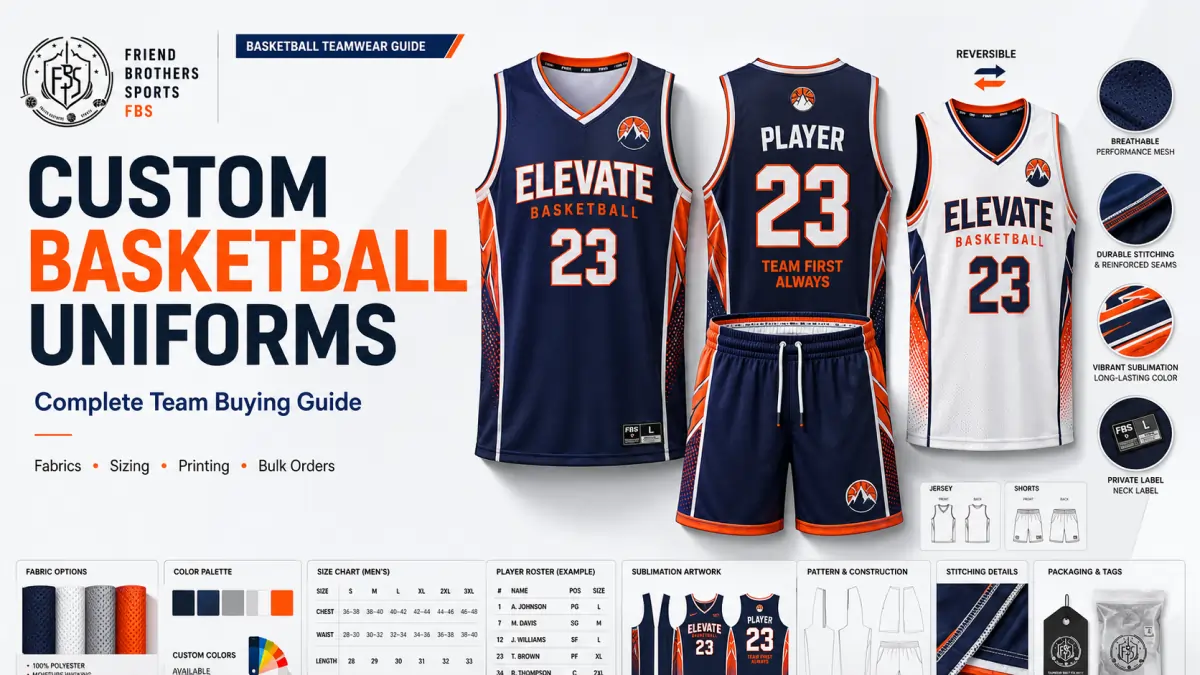
How to Choose Custom Basketball Uniforms for Your Team
Ordering uniforms for a basketball team involves more than choosing colors and adding a logo.
The right uniform must balance performance, fit, durability, branding, budget, and long-term reordering needs. A design may look impressive on screen, but if the fabric is too heavy, the size chart is unclear, or player details are submitted incorrectly, the final order can create unnecessary problems for the team.
This basketball uniform buying guide explains how schools, clubs, academies, leagues, distributors, and sportswear brands can plan custom basketball uniforms for teams more effectively.
It covers garment types, standard and reversible options, materials, printing methods, sizing, team rosters, minimum quantities, sampling, private-label production, delivery, and repeat orders.
For a complete overview of available product options, visit the custom basketball uniforms hub.
What Are Custom Basketball Uniforms for Teams?
Custom basketball uniforms for teams are made according to a specific club, school, academy, league, or brand identity.
Unlike generic ready-made uniforms, custom production allows buyers to control details such as:
- Team colors
- Logos and badges
- Player names
- Individual numbers
- Sponsor graphics
- Jersey neckline
- Armhole construction
- Side-panel design
- Shorts length
- Waistband type
- Fabric
- Fit
- Labels
- Packaging
A complete basketball uniform normally includes a jersey and matching shorts. Some teams order these pieces together, while others purchase jerseys or shorts separately for replacements, training, or roster expansion.
Custom production is especially useful when consistency matters. Teams can maintain the same colors, measurements, artwork, and branding across the entire roster rather than mixing garments from different suppliers.
Who Should Use This Basketball Uniform Buying Guide?
This guide is suitable for:
- School athletic departments
- Basketball clubs
- Youth academies
- Tournament organizers
- Community leagues
- University teams
- Sportswear distributors
- Uniform wholesalers
- Teamwear resellers
- Private-label athletic apparel brands
Each buyer has different priorities.
A school may prioritize durability and clear sizing. A club may want distinctive branding and repeat-order consistency. A distributor may require private-label packaging, barcode labels, and standardized specifications. A youth academy may need both child and adult sizes within one coordinated order.
The buying process should reflect the actual use case rather than following a one-size-fits-all template.
Start by Choosing the Correct Basketball Uniform Type
One of the first decisions is whether the team needs individual garments, a standard uniform set, or a reversible system.
Jersey-Only Orders
Jersey-only orders are suitable when a team:
- Already owns matching shorts
- Needs replacement tops
- Wants practice jerseys
- Is expanding the roster
- Needs separate staff or coaching variations
Teams requiring standalone jersey tops can review the custom basketball jerseys product page.
Shorts-Only Orders
Shorts may be ordered separately for:
- Replacements
- Training
- Teamwear resale
- New players
- Coordination with an existing jersey design
Standalone options are available on the custom basketball shorts page.
Standard Jersey-and-Shorts Sets
A standard basketball uniform set includes one non-reversible jersey and one matching pair of shorts.
This is usually the best option for teams that want:
- One complete playing outfit
- Consistent colors and artwork
- Coordinated sizing
- Matching side panels
- Simplified roster management
Teams looking for a coordinated package can review the custom basketball uniform set.
Reversible Basketball Uniforms
Reversible uniforms provide two wearable colorways in one set.
They are useful for:
- Practice
- Scrimmage
- Home and away use
- Training groups
- School programs
- Youth academies
A complete reversible set normally includes both a two-sided jersey and matching reversible shorts.
Teams considering this option can review the reversible basketball uniforms page.
Standard vs Reversible Basketball Uniforms
Both options can work well, but they serve different needs.
Standard Uniforms
Standard basketball team uniforms are usually lighter and simpler in construction.
They are suitable for:
- Competition
- League matches
- Tournament uniforms
- Teams with separate home and away kits
- Buyers prioritizing lighter garment weight
Standard uniforms also provide greater flexibility when using embroidery, screen printing, or applied decoration in selected areas.
Reversible Uniforms
Reversible uniforms provide two designs in one garment.
They are suitable for:
- Practice and training
- Scrimmage teams
- School programs
- Youth clubs
- Buyers who want two colorways without ordering two full sets
However, reversible construction requires more planning. Both sides must maintain good visibility, color contrast, number clarity, breathability, and comfort.
The choice should depend on the team’s actual use rather than price alone.
Basketball Uniforms for Schools
Basketball uniforms for schools must support regular use, repeated washing, changing rosters, and multiple size groups.
Schools should consider:
- Durable fabric
- Simple reordering
- Clear youth and adult sizing
- School colors
- Logo accuracy
- Readable numbers
- Easy-care materials
- Replacement garments
- Long-term design consistency
A school order may include junior, senior, boys’, girls’, and coaching sizes in one program.
It is important to separate each group clearly in the order sheet. For example, a medium in a youth pattern is not the same as a medium in an adult pattern.
Schools should also plan for spare garments. Injuries, new players, damaged uniforms, and roster changes can create mid-season needs.
Basketball Uniforms for Clubs and Academies
Basketball uniforms for clubs often require more detailed branding than school orders.
A club may want:
- Sponsor placement
- Multiple team divisions
- Academy and first-team variations
- Custom trims
- Private-label details
- Staff garments
- Home and away designs
- Repeat orders across multiple seasons
Club buyers should create a controlled specification for every garment. This can include:
- Approved artwork
- Exact color references
- Size chart
- Neckline shape
- Shorts length
- Fabric code
- Logo dimensions
- Label details
- Packaging instructions
A well-documented specification makes future reordering more reliable.
Choose the Right Fabric
Fabric affects comfort, print quality, durability, garment weight, breathability, and price.
There is no single best basketball fabric for every team.
Performance Polyester
Performance polyester is widely used because it can provide:
- Low garment weight
- Moisture management
- Fast drying
- Good print compatibility
- Durability
- Easy care
It is suitable for both training and competition uniforms.
Mesh Fabric
Mesh offers ventilation and a lightweight appearance.
It can work well for:
- Warm environments
- Training jerseys
- Practice uniforms
- Youth programs
- Reversible garments
However, very open mesh can reduce print sharpness and allow the reverse color to show through.
Interlock Polyester
Interlock fabric has a smoother surface and is often suitable for detailed sublimation.
It can support:
- Gradients
- Fine artwork
- Sponsor graphics
- Complex patterns
- Clear numbering
Moisture-Wicking Fabrics
Moisture-wicking materials are designed to move perspiration away from the body and dry more quickly.
Performance depends on the full fabric construction, not only the label. Yarn quality, knitting, finishing, garment fit, and ventilation all contribute.
Fabric Weight
Fabric weight is usually measured in GSM, but a higher GSM does not automatically mean better quality.
Teams should evaluate:
- Breathability
- Opacity
- Stretch recovery
- Durability
- Yarn strength
- Print compatibility
- Intended use
The ideal balance depends on whether the uniform is designed for competition, practice, reversible use, or frequent washing.
Select the Right Printing and Decoration Method
The design method should match the artwork, fabric, quantity, and intended use.
| Method | Best Use | Main Advantage |
|---|---|---|
| Full Sublimation | All-over designs, gradients, names, numbers, logos, and sponsor graphics | The artwork becomes part of the fabric without creating a heavy surface layer |
| Screen Printing | Simple logos, numbers, text, and repeat graphics | Efficient for suitable artwork and larger quantities |
| DTF Printing | Detailed multicolor logos and smaller graphic placements | Useful for complex artwork in selected areas |
| Embroidery | Club badges, brand marks, and premium logo placements | Creates a textured and professional finish |
| Heat-Applied Names and Numbers | Individual player personalization | Flexible for changing rosters and player-specific details |
Full Sublimation
Full sublimation is well suited to custom team basketball uniforms with:
- Multiple colors
- Gradients
- All-over patterns
- Player names
- Individual numbers
- Sponsor marks
- Complex side panels
The design becomes part of the fabric rather than forming a heavy layer on top.
Sublimation is especially practical for coordinated jersey-and-shorts designs.
Screen Printing
Screen printing can work well for simple logos, text, numbers, larger quantities, and limited-color artwork.
It is usually most efficient when the design remains relatively simple.
DTF Printing
DTF printing can reproduce detailed multicolor logos and smaller graphic placements.
It may be suitable for complex badges, sponsor graphics, lower placement quantities, and selected garment areas.
Embroidery
Embroidery creates a textured, premium appearance.
It is suitable for club badges, selected chest logos, brand marks, and premium teamwear.
However, large embroidered areas can add weight and stiffness to lightweight basketball garments.
Plan the Uniform Design Carefully
A strong basketball uniform design should look good from a distance and remain readable during movement.
Important design considerations include:
- Contrast between background and numbers
- Logo visibility
- Sponsor placement
- Side-panel alignment
- Jersey and shorts coordination
- Trim colors
- Font readability
- Front and back balance
Avoid placing essential details too close to seams, armholes, waistbands, or side joins.
Number Visibility
Player numbers should remain easy to read from both the front and back.
Teams should confirm:
- Number font
- Number height
- Number color
- Number outline
- Front placement
- Back placement
- Consistency across sizes
Sponsor Placement
Sponsor graphics should not interfere with player numbers or team branding.
Common positions may include:
- Upper chest
- Lower front
- Upper back
- Shorts leg
- Side panel
Logo Files
Vector artwork is preferred.
Files such as AI, EPS, SVG, or high-quality PDF usually provide better scaling than screenshots or low-resolution JPEG files.
Poor-quality artwork can lead to:
- Blurred edges
- Uneven shapes
- Incorrect colors
- Production delays
Prepare an Accurate Team Roster
One of the most common causes of custom uniform errors is an incomplete or inconsistent roster.
The roster should include:
- Player name
- Player number
- Jersey size
- Shorts size
- Fit type
- Quantity
- Team division
- Special notes
Do not assume jersey and shorts sizes are always the same.
Some players may need:
- A larger jersey
- Smaller shorts
- Longer shorts
- A women’s pattern
- A youth pattern
- A staff variation
Before production, one person should review the entire roster for:
- Duplicate numbers
- Misspelled names
- Missing sizes
- Inconsistent abbreviations
- Quantity mismatches
Once printing or sublimation begins, corrections may not be possible.
Understand Youth and Adult Sizing
Basketball uniforms for youth and adult teams should not rely only on labels such as small, medium, and large.
Measurements vary between manufacturers and markets.
Jersey Measurements
- Chest width
- Body length
- Shoulder width
- Armhole depth
- Neckline depth
Shorts Measurements
- Relaxed waist
- Extended waist
- Hip width
- Shorts length
- Leg opening
- Rise
Men’s, Women’s, and Unisex Patterns
A women’s pattern should not simply be a smaller men’s pattern.
Differences may include:
- Body shape
- Waist shaping
- Armhole depth
- Garment length
- Chest proportion
- Shorts cut
If fit is important, request a size chart and compare it with existing garments that already fit the team well.
Request Digital Mockups Before Production
A digital mockup helps the buyer review the visual design before manufacturing begins.
It should show:
- Front of jersey
- Back of jersey
- Front of shorts
- Back of shorts
- Logo placement
- Number placement
- Sponsor graphics
- Colorways
- Side panels
For reversible orders, both sides should be shown clearly.
A mockup is useful for design approval, but it does not confirm fabric feel, physical fit, exact printed color, garment weight, or seam quality.
These details require a physical sample.
Decide Whether a Physical Sample Is Necessary
A sample is strongly recommended when:
- The order is large
- The buyer has strict sizing requirements
- The design uses unusual construction
- Private-label packaging is required
- Color accuracy is critical
- The team is ordering for the first time
- A new size chart is being introduced
- Reversible construction is involved
During sample review, check:
- Fabric
- Weight
- Fit
- Jersey length
- Shorts length
- Number size
- Logo size
- Color
- Stitching
- Waistband
- Drawcord
- Labels
- Packaging
Sample approval should be written and specific.
Avoid approving a sample with vague comments such as “looks fine” if important details still need adjustment.
Understand MOQ and MCQ
MOQ means minimum order quantity.
MCQ means minimum color quantity.
The minimum quantity may depend on:
- Fabric
- Design
- Number of colorways
- Printing method
- Private-label requirements
- Packaging
- Garment construction
- Sample development
A buyer may meet the overall MOQ but divide the order into too many small designs.
For example, an order of 100 pieces divided across ten colorways is more complex than 100 pieces in one design.
To receive accurate guidance, provide:
- Total quantity
- Quantity per design
- Quantity per colorway
- Size breakdown
- Player roster
- Fabric preference
- Branding requirements
Planning Bulk Basketball Uniforms
Bulk basketball uniforms should be planned around the full team program, not only the first order.
Buyers should consider:
- Current roster
- Spare garments
- Coaching staff
- New players
- Mid-season replacements
- Future team divisions
- Repeat orders
A club ordering 20 uniforms may benefit from ordering additional blank or numbered garments for emergencies.
A distributor may need a more standardized size ratio for stock.
A school may need separate boys’, girls’, junior, and senior breakdowns.
The total quantity should reflect the actual operational need.
Wholesale and Distributor Orders
Wholesale basketball uniform orders often require more detailed commercial specifications.
Distributors may need:
- Private labels
- Custom packaging
- Barcode labels
- Size stickers
- Hang tags
- Carton markings
- Repeat production
- Multiple colorways
- Regional size charts
Wholesale buyers should define whether the products will be:
- Sold under the FBS brand
- Sold under the buyer’s private label
- Supplied as team orders
- Held as stock
- Customized after import
These details affect production planning.
OEM and Private-Label Basketball Uniforms
Private-label buyers can develop basketball uniforms under their own brand.
Available options may include:
- Woven neck labels
- Printed size labels
- Care labels
- Composition labels
- Hang tags
- Barcodes
- Custom polybags
- Branded cartons
- Buyer-specific artwork
For broader OEM support, visit the OEM and private-label sportswear manufacturing page.
Private-label buyers should confirm:
- Exact brand name
- Logo files
- Label dimensions
- Care instructions
- Country-of-origin wording
- Barcode information
- Packaging
- Carton requirements
Errors in label text or barcode data can create problems after production, so these details should be approved separately from the garment design.
Basketball Uniform Production Workflow
A typical basketball uniform production process may include:
- The buyer submits requirements.
- Quantity and size breakdown are reviewed.
- Fabric and decoration methods are selected.
- Digital artwork is prepared.
- Mockups are approved.
- A sample is developed where required.
- Sample corrections are confirmed.
- Bulk material is prepared.
- Printing or sublimation begins.
- Garments are cut and stitched.
- Quality control is completed.
- Uniforms are packed.
- Shipment is arranged.
Production should not begin until essential details are confirmed.
These include:
- Artwork
- Fabric
- Colors
- Roster
- Sizing
- Labels
- Packaging
- Payment arrangements
For a broader overview, review the custom sportswear manufacturing process.
Production Time
Production time varies according to:
- Quantity
- Fabric availability
- Design complexity
- Sampling
- Printing method
- Private-label details
- Approval speed
- Season
The production timeline should be discussed before the order is finalized.
Buyers should also allow time for:
- Artwork preparation
- Sample shipping
- Sample review
- Corrections
- Freight
- Customs clearance
An urgent deadline does not automatically reduce the time required for design approval and manufacturing.
Shipping and Delivery
Shipping time is separate from production time.
Delivery options may include:
- Express courier
- Air freight
- Sea freight
The best method depends on:
- Quantity
- Destination
- Shipment size
- Budget
- Deadline
Buyers should provide the complete delivery address or at least the city and postal code when requesting a quote.
A country name alone is not enough for accurate freight planning.
Friend Brothers Sports supports international buyers in the United States, United Kingdom, Europe, Canada, Australia, the Middle East, and other markets.
Quality-Control Checklist
Before shipment, the order should be checked against the approved specification.
Quality-control points may include:
- Fabric
- Color consistency
- Print placement
- Logo dimensions
- Player names
- Numbers
- Size labels
- Jersey measurements
- Shorts measurements
- Stitching
- Loose threads
- Waistband
- Drawcord
- Packing quantities
For reversible uniforms, both sides should be inspected.
The final packing list should also match the approved roster.
Planning Repeat Orders
Teams often need repeat orders after the first production run.
Possible reasons include:
- New players
- Lost uniforms
- Damaged garments
- Roster growth
- Additional teams
- Coaching staff
- New sponsors
Repeat orders are easier when the original specifications are documented.
Keep copies of:
- Artwork
- Color references
- Size chart
- Roster
- Fabric details
- Labels
- Packaging
- Approved sample
Even with saved specifications, fabric shades and materials may change over time, so repeat orders should still be reviewed before production.
Common Basketball Uniform Ordering Mistakes
Choosing by Price Alone
The cheapest option may compromise fabric, stitching, artwork, or consistency.
Compare the complete specification rather than only the unit price.
Submitting Low-Quality Logos
Low-resolution artwork can delay production and reduce print quality.
Use vector files whenever possible.
Mixing Size Systems
Do not combine youth, adult, men’s, women’s, and unisex sizes without clear labels.
Approving Artwork Without Checking the Roster
Verify every name, number, and size before approval.
Ignoring Shorts Specifications
Shorts length, waistband, drawcord, pockets, and side panels should be specified clearly.
Ordering Without Spare Uniforms
Teams often need extra garments during the season.
Waiting Until the Deadline Is Too Close
Allow time for design, sampling, production, shipping, and possible corrections.
Questions to Ask a Basketball Uniform Manufacturer
Before placing an order, ask:
- What fabrics are available?
- Is the garment standard or reversible?
- What printing methods are suitable?
- Can youth and adult sizes be combined?
- Is a sample available?
- What is the MOQ?
- Is there a minimum quantity per color?
- Can names and numbers be customized?
- Are labels and packaging available?
- How are repeat orders handled?
- What is the production timeline?
- What shipping methods are available?
- What files are needed for artwork?
- What quality checks are performed?
A reliable manufacturer should provide clear answers based on the actual order specification.
Final Basketball Uniform Buying Checklist
Before requesting a quotation, prepare:
- Product type
- Standard or reversible construction
- Total quantity
- Quantity per design
- Quantity per colorway
- Size breakdown
- Player roster
- Team colors
- Logo files
- Sponsor artwork
- Fabric preference
- Jersey style
- Shorts length
- Printing method
- Label requirements
- Packaging
- Delivery destination
- Required deadline
The more complete the information, the more accurate the quotation and production plan will be.
Frequently Asked Questions
What should a complete basketball team uniform include?
A complete basketball team uniform normally includes a jersey and matching shorts. Some teams also order warmups, shooting shirts, socks, or staff garments separately.
Can youth and adult sizes be included in one order?
Yes. Youth and adult sizes can be combined, but they should be clearly separated in the final size breakdown and roster.
Are reversible uniforms suitable for competitive games?
Yes, depending on the league and design requirements. Teams should confirm local competition rules and ensure numbers and colors remain clearly visible.
Can each player have a different name and number?
Yes. Individual names, numbers, and sizes can be added to each uniform. The final roster should be verified carefully before production.
What is the best fabric for basketball uniforms?
The best fabric depends on the intended use. Mesh supports ventilation, while smooth polyester interlock can provide better detail for sublimated artwork. Breathability, weight, durability, and print requirements should all be considered.
Is sublimation better than screen printing?
Neither method is always better. Sublimation works well for complex all-over designs, while screen printing may suit simpler artwork and larger quantities.
Can schools order replacement uniforms later?
Yes, but repeat production is easier when the original artwork, colors, measurements, fabric, and labels are documented.
What information is needed for a bulk basketball uniform quote?
Provide quantity, sizes, player names and numbers, design, colors, fabric preference, branding, packaging, delivery location, and deadline.
Can basketball uniforms be produced under a private label?
Yes. Private-label production can include custom labels, hang tags, barcodes, polybags, and buyer-specific packaging.
How can I request a quotation?
Submit your requirements through the custom sportswear quote page.
Request a Custom Basketball Uniform Quote
Choosing basketball team uniforms becomes easier when the product type, fabric, artwork, sizing, roster, and delivery requirements are planned before production.
Friend Brothers Sports supports schools, clubs, academies, leagues, distributors, wholesalers, and private-label brands with standard uniforms, reversible sets, jerseys, shorts, singlets, sampling, OEM production, and worldwide shipping.
To begin, prepare your quantity, size breakdown, team colors, logo files, player roster, fabric preference, branding requirements, and delivery destination.
Contact Friend Brothers Sports on WhatsApp:
+92 300 1722538
Or submit the complete project details through the official quotation page: