
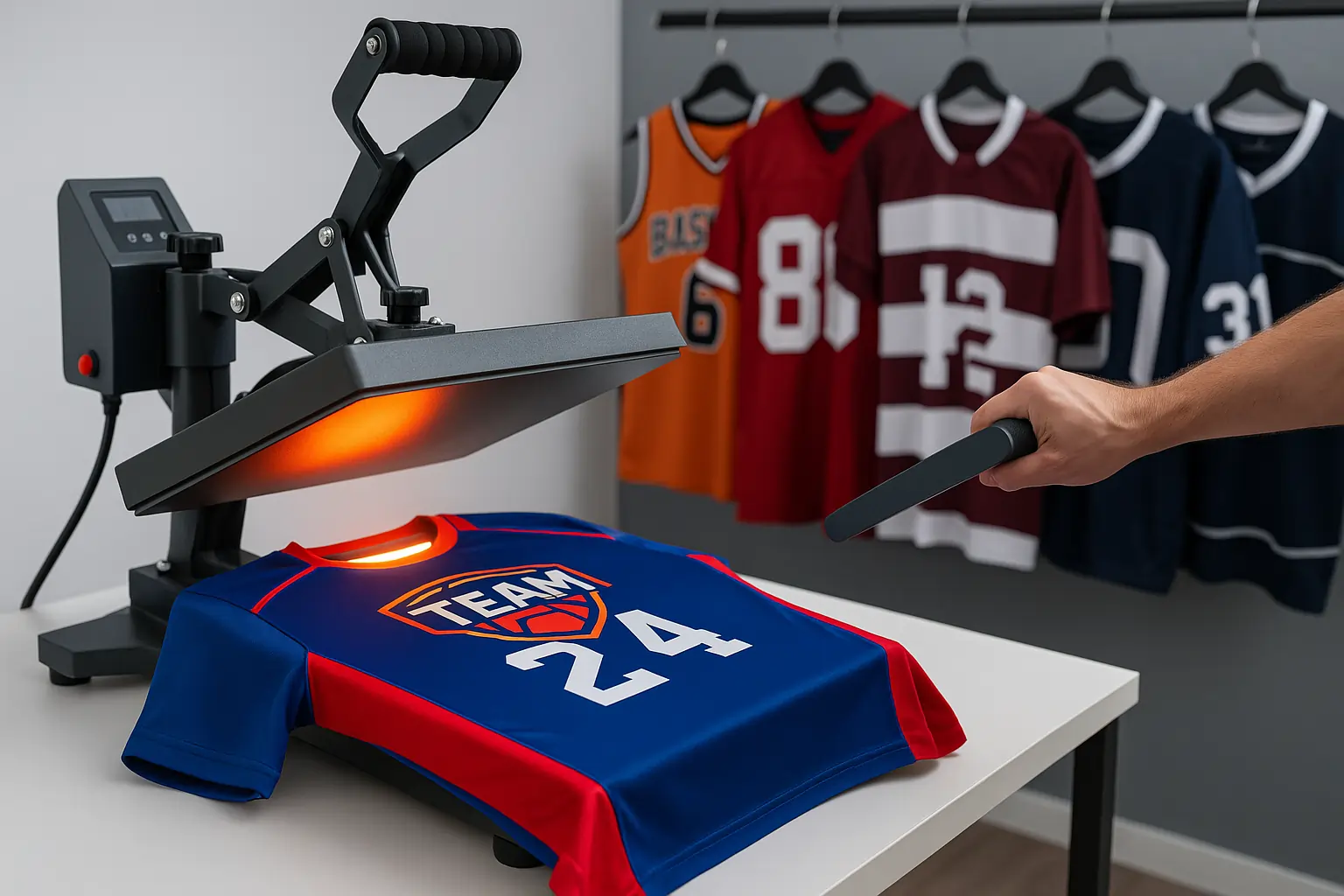
Heat press customization is widely used in sportswear to apply names, numbers, logos, badges and selected graphics to jerseys and other team apparel. For teams, clubs, academies and sportswear buyers, the important question is not simply whether heat press technology is available, but when it is the right decoration method for a particular garment and design.
In this guide, we explain how heat press jerseys are produced, what can be applied using heat transfer, and how this method compares with sublimation and embroidery in custom sports uniform manufacturing.
What Is a Heat Press Jersey?
A heat press jersey is a sports garment where selected design elements are applied using controlled heat and pressure. Depending on the transfer material and garment, this method can be used for player names, numbers, team logos, sponsor marks, badges and other localized graphics.
Unlike all-over sublimation, which integrates the design into suitable fabric during production, heat pressing usually adds specific design elements to an already prepared garment or garment panel.
How Does Heat Pressing Work on Sports Uniforms?
The basic process uses a heat press machine to apply a prepared transfer onto the garment surface. Heat and pressure activate the transfer system so the graphic bonds to the material.
The exact process depends on several factors, including:
- The garment fabric
- The type of transfer material
- The size and placement of the design
- The intended use of the uniform
- The required appearance and finish
For this reason, the decoration method should be selected according to the garment and application rather than using one printing method for every sportswear product.
What Can Be Heat Pressed onto a Jersey?
Heat transfer can be suitable for many localized jersey details, including:
- Player names
- Player numbers
- Team logos
- Sponsor logos
- Badges and patches
- Small graphic elements
This makes heat pressing useful when buyers need specific areas of the garment customized without creating an all-over printed design.
Heat Press Jerseys vs Sublimation
Heat press and sublimation serve different purposes in custom sportswear manufacturing.
Sublimation is commonly used when the design covers large areas of suitable polyester fabric. Colors, patterns, numbers, names and graphics can become part of the overall garment design.
Heat press customization is often better suited to specific names, numbers, logos or additional graphic elements applied to defined areas of the jersey.
For example, a team may use a sublimated jersey design while still requiring certain badges, sponsor marks or additional elements to be applied separately.
You can learn more about the different customization methods used by Friend Brothers Sports on our sportswear manufacturing technologies page.
Heat Press vs Embroidery
Embroidery creates a stitched finish and is often used where buyers want a more textured or traditional appearance. Heat transfer produces a flatter graphic application and can be more suitable for certain names, numbers, sponsor marks and detailed designs.
The better option depends on the garment, design, placement and desired finish.
For example, embroidery may work well for selected logos on tracksuits, polo shirts or outerwear, while heat-applied graphics may be more appropriate for certain jersey numbers or sponsor details.
When Should Teams Choose Heat Transfer?
Heat transfer may be worth considering when a team or buyer needs:
- Player names and numbers
- Localized team branding
- Sponsor logos
- Additional badges or graphics
- Customization on garments where all-over sublimation is unnecessary
- Specific design elements added to an existing sportswear design
It should not automatically be treated as the best method for every uniform. Fabric type, design complexity, garment use and production requirements all matter.
Fabric and Design Considerations
The performance of a heat-applied graphic depends on the relationship between the transfer system and the garment material.
Before production, manufacturers need to consider factors such as:
- Fabric composition
- Surface texture
- Stretch requirements
- Graphic size
- Placement
- Garment construction
- Expected playing or training conditions
This is why professional sportswear production should treat decoration as part of the overall garment-development process rather than as a separate final step.
Heat Press in Custom Sportswear Manufacturing
For a custom sportswear manufacturer, heat transfer is one tool within a broader production system.
Different orders may require different techniques, including:
- Sublimation
- Heat transfer
- DTF printing
- Embroidery
- Other suitable garment-decoration methods
The right choice depends on the buyer’s design, fabric, branding requirements and intended product.
Friend Brothers Sports manufactures custom sports apparel and team uniforms for clubs, academies, distributors, sportswear businesses and other B2B buyers. Our production approach allows the decoration method to be matched with the garment instead of forcing every design into the same process.
Heat Press for Different Sports Jerseys
Heat-applied customization can be relevant across different sports depending on the uniform design.
Basketball Jerseys
Names, numbers, logos and selected branding elements may be added to basketball uniforms depending on the material and design specification.
For complete team-uniform options, see our custom basketball uniforms.
Football and Soccer Jerseys
Player names, numbers, sponsor marks and badges are common customization requirements for football and soccer teams.
Explore our custom football uniforms for team and bulk manufacturing requirements.
Rugby Jerseys
Rugby garments require decoration methods that are selected carefully according to fabric, construction and playing requirements.
See our custom rugby uniforms for custom team manufacturing.
Heat Press Jersey FAQs
Can you heat press jersey material?
Many jersey materials can accept suitable heat-applied decoration, but compatibility depends on the fabric and transfer system. The garment material should always be evaluated before production.
Are jersey numbers heat pressed?
Jersey numbers can be applied using heat-transfer methods, although other production methods such as sublimation may also be used depending on the garment design and manufacturing process.
Are all custom jerseys heat pressed?
No. Custom jerseys can use different decoration methods, including sublimation, heat transfer, embroidery and other printing techniques. The correct method depends on the design, fabric and intended application.
Is heat press better than sublimation?
Neither method is universally better. Sublimation is well suited to suitable polyester garments and all-over designs, while heat transfer can be useful for localized names, numbers, logos and other selected graphics.
Can team logos be applied with a heat press?
Yes, suitable logos and badges can be applied using heat-transfer methods when the garment fabric and transfer material are compatible.
Choosing the Right Customization Method
The best sports uniform is not determined by one printing technology. It comes from selecting the right combination of fabric, construction, decoration method and design for the intended use.
Heat press customization can be valuable for names, numbers, logos and localized graphics, while sublimation, embroidery and other methods may be more appropriate for different requirements.
For teams, clubs, academies, distributors and sportswear brands, the best approach is to share the complete design and garment requirements with the manufacturer before choosing the decoration method.
Planning Custom Team Uniforms?
Friend Brothers Sports manufactures custom team uniforms, OEM sportswear and private-label sports apparel for international B2B buyers.
Send us your design, sport, quantity requirements and customization details. We can review the garment and recommend a suitable production and decoration approach for your order.